Technical Activities Tech Expo and Avishkar
In the modern era of Information technology, Tech Expo aims to provide knowledge about IT & related technologies right from the evolution of various computer technologies. Over the last few decades, knowledge related to Android Projects, different programming languages, and hardware components has changed dynamically.
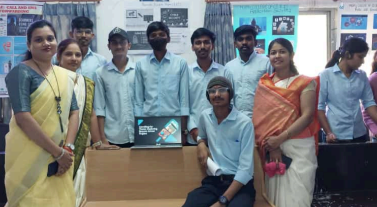
The Tech Expo is organized to show theoretical as well as practical demonstrations of concepts, studied mostly in books, in reality, that will help the student to clear the concepts. The event is suitable for everyone like Student, their Parents & Teachers.
Tech Expo is the paramount event organized by MGM College to enhance the special skills of the students so that they can get good exposure, knowledge about the subject, and recent updates. Tech Expo not only gives information to students in different dimensions but also gives 360-degree learning skills to students. Tech Expo is an excellent medium for delivering information to students.
FEATURES OF TECH EXPO :-
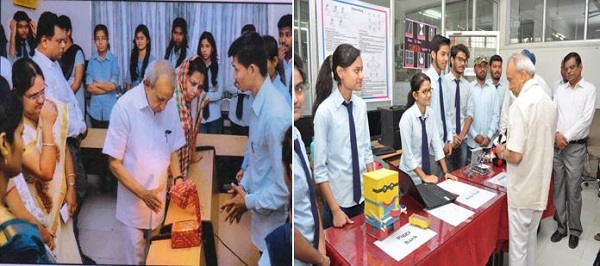
Hard Expo: Under this title students expose their hardware experiments and give information about that, they deliver knowledge about computer hardware and peripherals. The hard expo demonstrates all kinds of information about computer-related hardware parts. Such as LCD, LED, Hard disk, processors, and such instruments will be displayed in the hard expo. All the peripheral device information will be shown in the hard expo.
Project Expo: In this section gave all the information related to project development to the students, so that they will complete their project with ease. That guidance is helpful for the student to build their final-year projects.
Visual Expo: Displays all the videos related to IT industries. In this section we will display visual information of all upcoming new technologies.
Robotic Expo: Robotics is an interdisciplinary engineering science that includes mechanical engineering, electrical engineering, computer science, and others. Robotics deals with the design, construction, and operation, as well as computer systems for their control, sensory feedback, and information processing.
These technologies are used to develop machines that can substitute for humans and replicate human actions. Robots can be used in any situation and for any purpose, but today many are used in dangerous environments (including bomb detection and de-activation), manufacturing processes, or where humans cannot survive. Robots can take on any form but some are made to resemble humans in appearance.
This is said to help in the acceptance of a robot in certain replicative behaviors usually performed by people. Such robots attempt to replicate walking, lifting, speech, cognition, and anything a human can do. Many of today’s robots are inspired by nature, contributing to the field of bio-inspired robotics. Various Robots developed by our Students were demonstrated.
PROJECT-BASED LEARNING & INNOVATION SHOWCASE
“From idea to impact – every project is a journey of transformation.”
MINI PROJECTS
(Hands-on Learning Every Semester)
Our institution strongly emphasizes experiential learning. To encourage creativity and application-oriented thinking, Mini Projects are compulsory in each semester for all students. These projects help students bridge the gap between theoretical knowledge and practical implementation. Guided by faculty mentors, students work in teams to develop functional prototypes or software applications, often targeting real-world problems and community needs.
PROJECT COMPETITION
(Fueling Innovation through Challenges)
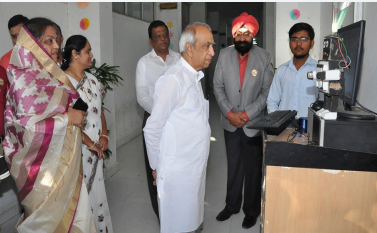
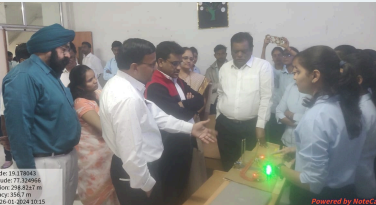
To motivate students further, the college organizes project competitions. These events provide a platform for showcasing innovations, receiving expert feedback, and developing presentation and teamwork skills. Winning projects receive awards, certification, and further mentoring support for the participation in National Events, hackathons, coding competitions and research festivals like “Avishkar”.
Impact:
- Encourages innovation from the first year.
- Builds technical and presentation skills.
- Enhances team collaboration.
- Links academics to real-world problems.
- Fosters entrepreneurship and research culture.